

Canadian Buddy Holly fan makes somber pilgrimage to Clear Lake
by Dustin A. Woods
Back in grade school when other kids were listening to songs like “Baby Beluga” and “Wheels on the Bus,” I was poring over my parents’ classic record collection. Sitting through dusty old boxes of vinyl, I would scrounge and try to find, as I haphazardly traced back to the roots of rock ’n’ roll, any old record at a time.
Carefully placing the needle down would magically unveil a whole new world of discovery and wonder. I would study the jackets, looking for clues of who these musicians and groups were. The greatest revelation of all was the discovery of a boy from Lubbock, Texas, named Charles Hardin Holley, known famously as Buddy Holly.
I obsessively consumed his relatively prolific body of work. By then I had become vaguely familiar with gospel, blues, country, western, but this was all new past together in a melodic orchestra of sounds that was unlike anything I’d ever heard before. Even now I can’t help but wonder how a middle-class kid from Lubbock cosmically channeled sounds that defied genre, race, space, and time in only a few short years. The curiosity and excitement continued to swell before crashing down with the discovery of his premature and tragic death.
Over the years, I have sought out every possible piece of work related to his life, including books, albums, and documentaries. The more I learned, the more heart-wrenching his story became. The fact that he had just recently been married and was expecting a child, that his trusted band parted ways, and he had only joined the ill-fated Winter Dance Party tour.
I wanted to learn more about the man, how he lived, and see where he played his last show. I felt deeply compelled to pay my respects where his life came to an end and see his final resting place. My trip would include the Rock & Roll Hall of Fame in Cleveland, Ohio, and Lubbock, Texas, to see where Buddy Holly lived. But the most significant destination was the Buddy Holly Center, where performing arts center that bears his name, and pay my respects at his statue and humble grave site, followed by the Surf Ballroom and the surrounding crash site.
Cross-crossing the country on a beautiful new motorcycle in the summer heat, I couldn’t help imagining the struggle members of the Winter Dance Party endured making the trip in a leaky old bus in the icy depths of winter in 1959.
Following the streets bearing the names of Holly, Ritchie Valens, and J.P. “The Big Bopper” Richardson, I approached the legendary Surf Ballroom in Clear Lake. Entering the historic building felt like traveling back in time. It felt surreal to consider a religion of sorts, the Surf’s purely holy place. The Surf was once a place where young people gathered to experience something magical.
I scanned the walls full of artists who performed on Clear Lake’s legendary Surf Ballroom stage where the music lives.
But it’s not just because his agent had tied up all his money in other investments. And perhaps most notably that his life was so violently cut short in the horrific and mysterious crash of a small plane that would never take off in the first place.
In addition to our optical challenges and mutual fondness for fine suits and music, Buddy Holly and I also share a common passion for motorcycles. He was famously turned away from a Harley-Davidson dealership by a salesman who thought he was too young to afford a motorcycle, so he purchased an Indian motorcycle, a newly minted shop owner of the last 20 years. I have been reviewing motorcycles and creating travel content for a variety of outlets. Having a Harley-Davidson Street Glide to review, I had some free time on my calendar this summer, and decided my vacation to making a somber pilgrimage to prominent locations in Buddy Holly’s life and final days.
Standing on the very stage where Holly played his final song and walking through the very dressing room where the infamous coin flip was made felt otherworldly. Seeing the phone booth where Buddy Holly made his last call to his wife, Elena, and Elwin Musser’s camera that captured the scenes of the iconic crash brought the stories I had read about to life so vividly.
My physical and spiritual journey took me to the Three Stars Plaza musical installation, followed by a visit to the Snap-On Café nearby exhibit, then the Mason City Airport where the doomed flight departed from. From there, I was driven to the cornfields at the crash site. Witnessing the quiet contemplation and families with young kids also traveling to pay their own respects at the Surf Ballroom and crash site memorial, I have come to truly understand why music continues to be enjoyed by future generations.
Click here to learn how to visit the Buddy Holly Crash Site
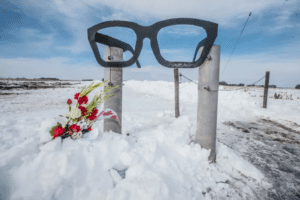
The trailhead to the memorial is marked by a pair of Buddy Holly’s signature glasses.