
Before refrigeration, winter in Clear Lake wasn’t just a season, it was an industry.
For decades, thick ice cut from the frozen surface of Clear Lake was harvested, stored, and shipped across Iowa to keep food fresh through the summer months. At its peak, the ice harvest here was one of the largest in the region, employing dozens of workers and moving tens of thousands of tons of ice in a matter of weeks.
A Record-Breaking Winter
In March 1912, Clear Lake closed out what newspapers called the biggest ice harvest in the lake’s history. According to a report published by the Marshalltown Times-Republican, more than 25,000 tons of ice were taken from the lake that season.
In just 34 days, 555 railcars of ice were shipped out, with destinations as far away as Clinton. Another 6,500 tons were stored locally for late-summer use. The ice itself froze to a depth of 35 inches, then was planed down to various thicknesses depending on where it would be used.
The harvest put more than $5,000 in wages into the local economy in a short time which was a meaningful boost during winter months when other work slowed.
Where the Ice Went
Historical maps and newspaper accounts suggest Clear Lake had at least three ice houses over time.
The primary and longest-running ice house stood on North 6th Street, between what are now 2nd and 3rd Avenue North, where the United Methodist Church stands today. This facility appears on Sanborn maps beginning in the early 1900s and was operated first by Stewart Brothers, then later by Choate & Chizek, remaining in use into the mid-20th century.
Another ice house once stood near today’s City Beach, along what is now South Shore Drive. This building appears on early maps but was destroyed by fire in 1912, along with thousands of tons of stored ice. It was never rebuilt.
A third ice house, stood along North Shore Drive, across from the golf course, at what is now 2317 N. Shore Drive. While maps don’t definitively label this structure as an ice house, newspaper accounts from the 1940s suggest Stewart Brothers were still filling an ice house at that time, possibly at this location.
Ice being harvested along North Shore Drive. Photo from Marcia Green, Lost Clear Lake.
How the Harvest Worked
Ice harvesting was a coordinated effort involving multiple companies.
Historical accounts point to S.C. Culver and the Culver Ice Company as the primary harvesters — organizing crews, cutting the ice, and moving it off the lake. Storage and distribution were handled by businesses including Stewart Brothers, Choate & Chizek, and Crystal Lake Ice, which supplied communities throughout north-central Iowa.
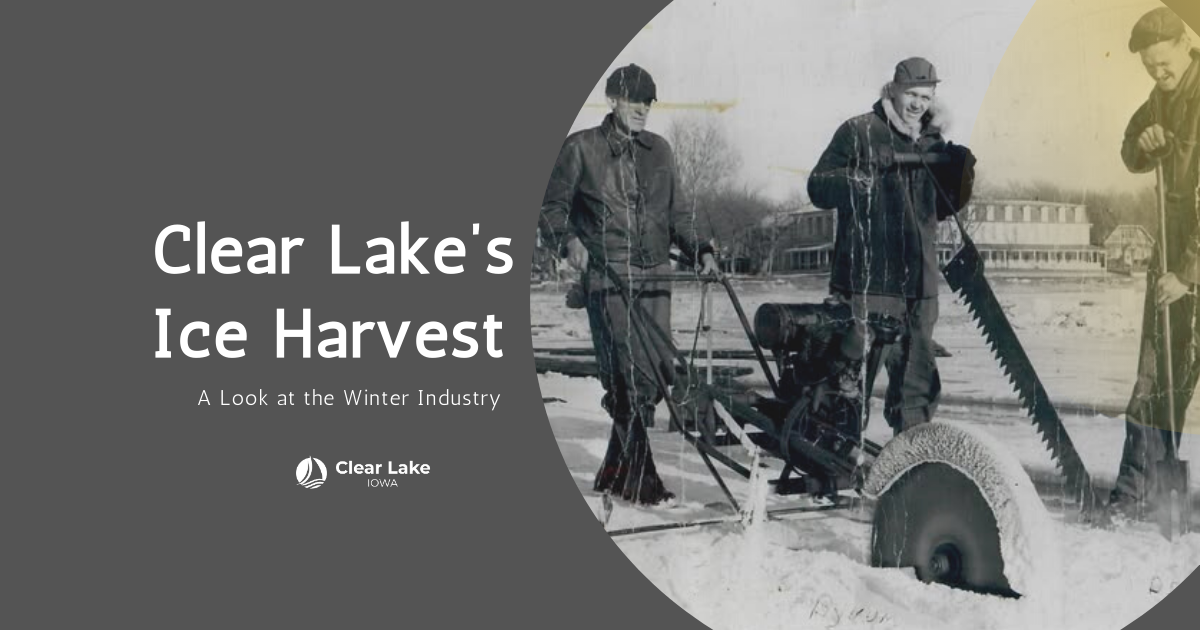
By 1916, new technology was already changing the process. An electric ice cutter — a large circular saw — was tested on Clear Lake, significantly speeding up production.
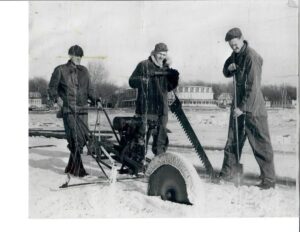
Chris Jacobsen, Bing & Delmar cutting blocks of ice from Clear Lake to store for the summer months. – Photo from Stephen Jacobsen, Lost Clear Lake
A Winter Industry Lost to Time
By the mid-20th century, mechanical refrigeration had replaced the need for natural ice. The ice houses disappeared, the rail shipments stopped, and what had once been a major winter operation quietly faded from memory.
Today, most visitors see Clear Lake frozen over and think of fishing, snowmobiling, skating, kites, ice boating, or snow-covered views. Few realize that the ice beneath their boots once powered a regional industry: one that helped shape the town’s economy and identity during its earliest decades.
Clear Lake’s ice harvest is a reminder that winter here has always been more than something to endure, it was something people worked, built, and lived from.
This story is based on historical newspaper accounts, Sanborn maps, and research shared through the Lost Clear Lake community.